
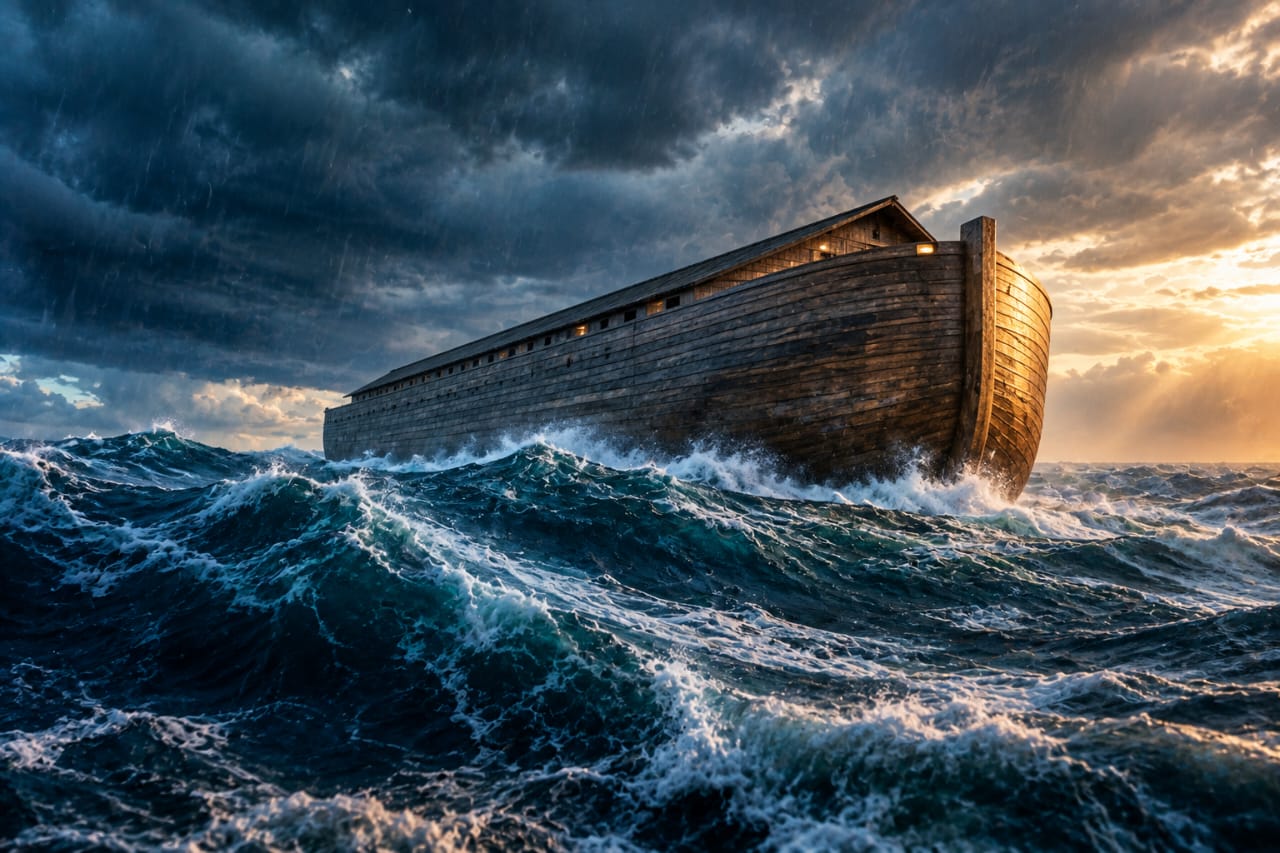
For thousands of years, the story of Noah’s Ark has remained one of the Bible’s most familiar accounts. Now, an ancient boat-shaped formation in Türkiye is once again drawing attention as researchers investigate what may be hidden beneath the ground.
The formation, known as the Durupınar site, has attracted interest because of its unusual shape and its proximity to the biblical location traditionally associated with Mount Ararat. Researchers have been examining the site for years, using geological surveys, soil analysis and other forms of investigation to determine what lies beneath it.
But there is an important distinction between investigating a possible archaeological site and proving that it is Noah’s Ark.
According to the biblical account in Genesis, God instructed Noah to build an enormous ark before sending a flood that would cover the earth. Noah, his family and representatives of the animal kingdom were preserved inside the vessel.
Genesis 8:4 says the ark came to rest “on the mountains of Ararat.”
For believers, that passage has made the region particularly significant. For researchers, however, the question is more complicated: does the geological formation actually contain evidence of a man-made structure, or is its unusual appearance the result of natural processes?
That is where the current investigation becomes interesting.
Researchers have reportedly identified features within the formation that they believe deserve further examination, including soil and structural patterns that could potentially indicate human activity.
At the same time, geological explanations have also been proposed for the formation, meaning the evidence remains open to interpretation.
In other words, the shape alone cannot settle the question.
And that distinction matters, especially when a discovery is connected to a story as significant as Noah’s Ark. It is easy for excitement to turn an intriguing finding into a definitive conclusion before the evidence has reached that point.
The Christian response does not have to be either blind acceptance or immediate dismissal.
The Bible itself contains several accounts that invite people to examine what they hear and consider what is true. Acts 17:11 commends the Bereans because they examined the Scriptures carefully to determine whether what they were being taught was true.
The search surrounding the Durupınar formation raises a similar question about how we approach discoveries connected to faith.If researchers eventually uncover evidence that supports the possibility of an ancient vessel at the site, it would undoubtedly generate significant archaeological and theological discussion.
If the evidence instead demonstrates that the formation is entirely natural, that would also be an important finding.
Either way, the investigation is worth following because it sits at an unusual intersection of faith, history, archaeology and scientific inquiry.
There is also a deeper reason the story continues to attract attention.
For Christians, the account of Noah is not simply about a giant boat. It is a story about obedience, judgment, preservation and God’s instructions to a generation that had become deeply corrupt.
Hebrews 11:7 describes Noah as a man who acted by faith when warned about things he had not yet seen. His obedience came before the evidence of the coming flood was visible.
That part of the story remains significant regardless of what researchers eventually discover beneath the Turkish formation.At the same time, Christians should be careful not to make archaeological discoveries carry a burden they were never designed to carry. The truth of Christianity does not depend entirely on whether a particular geological formation turns out to be Noah’s Ark.
The biblical account stands on its own theological claims.
Still, discoveries that cause people to revisit ancient biblical narratives can open valuable conversations.
They can encourage people who have never seriously considered Scripture to ask questions about its historical setting, its accounts and the traditions that have survived across generations.
Perhaps that is why the investigation has captured so much attention.
People are not simply looking at a strange formation in the earth. They are looking at a possibility connected to one of humanity’s oldest stories.
For now, the investigation continues, and the evidence is still being examined. The formation has not been conclusively established as Noah’s Ark, and other geological explanations remain part of the discussion.
But beneath the ground in Türkiye, an ancient mystery continues to draw scientists, historians, Christians and curious observers back to a story that has survived for thousands of years.
Whether the investigation eventually uncovers a remarkable archaeological discovery or simply explains a remarkable natural formation, one question will remain worth asking:
What really lies beneath?