
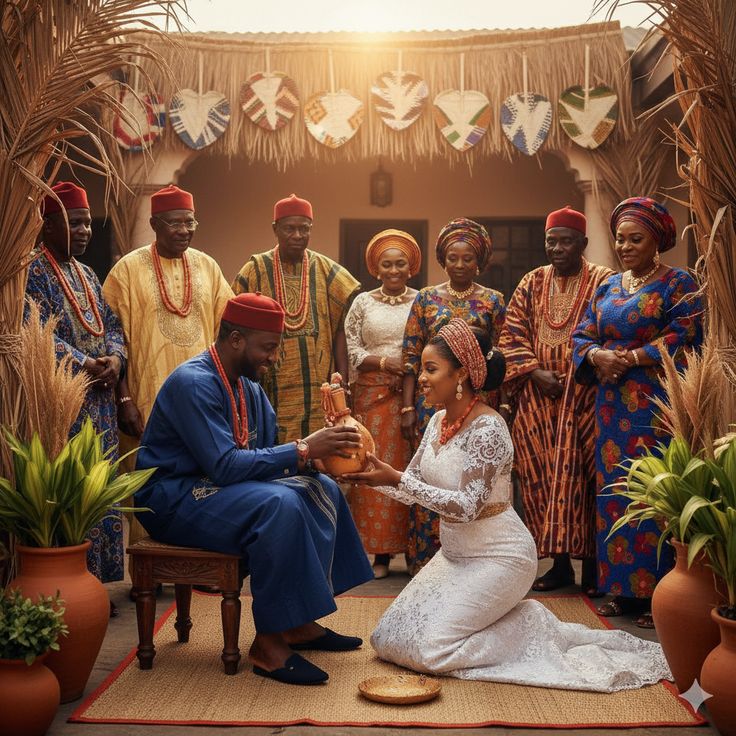
In many Nigerian communities, marriage is not simply the day a man and woman exchange vows. It is the joining of families, the recognition of cultural identity and the beginning of a responsibility that extends beyond the couple. This is why, even as modern relationships and wedding celebrations continue to change, traditional marriage rites remain important to many Nigerians.
For generations, marriage has carried a meaning that goes beyond romantic love. It is an agreement involving two people, their families and, in some communities, the wider society. The formal introduction of families, payment of bride price, presentation of gifts and symbolic ceremonies are not merely activities arranged to make a wedding colourful. They represent acceptance, respect and the recognition of a new family relationship.
Across Nigeria, these customs take different forms. Among the Igbo, the Igba Nkwu ceremony, commonly known as the wine-carrying ceremony, is one of the most recognised parts of traditional marriage. The bride searches for her groom among the guests and presents him with a cup of palm wine, publicly identifying the man she intends to marry. In Yoruba traditional weddings, the engagement ceremony often features the Alága, who guides the proceedings, while the groom and his friends may prostrate before the bride’s family as a demonstration of respect. Other communities have their own practices, gifts, family negotiations and symbolic rites. These differences reflect the cultural variety that makes Nigerian marriage traditions distinctive.
But beyond the ceremonies themselves is something that has helped keep these traditions alive: the value attached to marriage and the expectations surrounding it.
In many Nigerian homes, marriage is traditionally regarded as a serious lifelong commitment. Couples are encouraged to respect one another, protect the family and make efforts to resolve disagreements rather than immediately abandon the relationship. Women, in particular, have often been raised with strong expectations about building a home, respecting their husbands and remaining committed through difficult seasons. Men, too, are expected to provide, protect and take responsibility for their families.
This cultural emphasis on commitment is also reinforced by religion. In many Christian and Muslim households, marriage is understood as more than a social arrangement. It carries spiritual responsibilities. Couples are encouraged to pray, seek counsel, exercise patience and work towards keeping their homes together. For Christians, passages such as Matthew 19:6, which teaches that what God has joined together should not be separated by human beings, are frequently used to emphasise the seriousness of marriage.
However, commitment should not be confused with enduring abuse or remaining in an unsafe home. A woman choosing to leave a harmful marriage is not necessarily disrespecting her culture or failing in her responsibilities. The value of a lasting marriage should include the safety, dignity and wellbeing of both partners.
It is also common to hear comparisons between Nigerian marriages and those in Western countries, particularly around divorce. Some Nigerians believe that couples in previous generations were more willing to endure marital difficulties and that today’s relationships are more easily abandoned. While this perception is part of the conversation about changing family values, it would be unfair to suggest that Nigerian women never seek divorce or that people in other countries do not value commitment. Divorce happens in Nigeria too, and the reasons people leave marriages are often complex. What is clear is that family expectations, religious beliefs and social attitudes can influence how couples approach separation.
Another part of the conversation is the changing attitude towards polygamy. In some Nigerian communities, a man marrying more than one wife was historically accepted under customary or religious practices. Polygamy was not necessarily viewed as an unusual arrangement, although its acceptance and conditions differed across ethnic groups, families and religious communities. Nigerian customary marriage, for example, can accommodate a man having more than one wife, depending on the applicable custom.
Today, however, many Nigerians increasingly express a preference for monogamous marriages, where one man is married to one woman. Religious teachings, education, changing social expectations, exposure to other cultures and conversations on social media have all influenced how younger people understand marriage. For some, having one partner is a personal conviction; for others, it is a religious requirement or simply the kind of relationship they want to build.
Christian discussions about monogamy often refer to Genesis 2:24, which says that a man leaves his father and mother and is joined to his wife, and the two become one flesh. Jesus also refers to this passage in Matthew 19:4–6 when teaching about marriage and divorce. Many Christians interpret these verses as establishing monogamy as the ideal for marriage.
Yet the Old Testament contains accounts of men who had multiple wives. Abraham had Sarah and Hagar, Jacob married Leah and Rachel, while David and Solomon also had multiple wives. Deuteronomy 21:15–17 even addresses the rights of children born to a man with two wives. These accounts show that plural marriage existed in the biblical world, although the presence of a practice in Scripture does not automatically mean that every part of it is presented as an ideal to follow.
This is where conversations about culture, religion and modern marriage become particularly interesting. Some people believe that the growing preference for monogamy reflects the influence of Western values, while others see it as a personal interpretation of Christian teaching and a deliberate choice about the kind of home they want. Neither position should be reduced to the idea that Nigerians are simply copying foreigners. Nigerian society has always been influenced by encounters with other cultures, and marriage practices have evolved over time.
What remains important is that the discussion should not become a competition between one-wife and multiple-wife marriages. A marriage’s success cannot be measured by the number of wives a man has, just as a monogamous arrangement does not automatically guarantee peace and happiness. Respect, honesty, responsibility, mutual understanding and genuine commitment matter in every marriage.
There is also a legal distinction worth understanding. Nigeria recognises marriages under customary law, Islamic law and the statutory Marriage Act. A statutory marriage is monogamous, while customary marriage may permit polygamy according to the applicable tradition. A church wedding is legally a statutory marriage only when the requirements of the Marriage Act are met; a religious ceremony does not automatically acquire that legal status simply because it takes place in a church.
Ultimately, traditional marriage rites remain meaningful because they connect people to their families, communities and cultural histories. They remind younger generations that marriage has long carried responsibilities that extend beyond the wedding celebration. As Nigerians embrace new ideas about relationships, religion and family life, the challenge is not necessarily to abandon tradition or reject change, but to understand the values behind these practices and decide how they can continue to shape healthy marriages.