
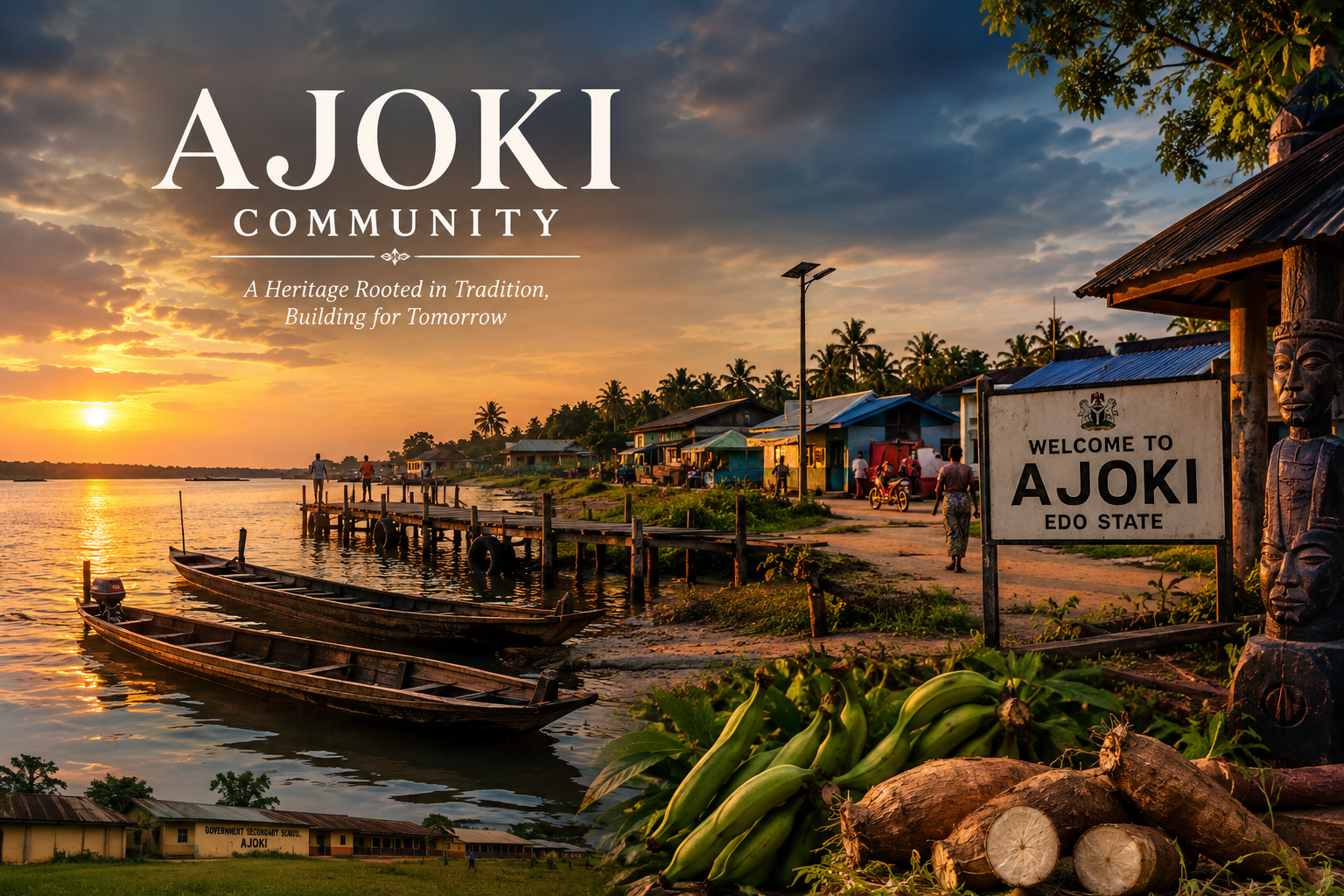
Founded in 1835, Ajoki Community in Edo State carries a history that stretches across generations. From its roots in farming, fishing and hunting to the changing professions of its people today, the community has evolved with time while preserving traditions that remain part of its identity.
The Story Behind Ajoki’s Founding
According to accounts provided by the community, Ajoki was founded in 1835 by Oki Branadu, a grandchild of Iyatsere Egharegbemi of Watri Kingdom. Oki was also said to have been a stepbrother to Ikaye Branadu of Ologbo.
The community’s history is closely tied to Oki and his sister, Olire. Their descendants are represented through the family stocks of Ama, Olire, Ukpu, Okene, Igo, Odorma and Kpukpuru, which continue to form part of Ajoki’s traditional community structure.
For generations, Ajoki’s identity has been shaped by the people who have lived there, their occupations, traditions and systems of community organisation.
From Traditional Occupations to Modern Professions
Farming, fishing and hunting have traditionally been major occupations among the people of Ajoki.
However, as urbanisation and Western education have influenced the community, Ajoki indigenes have increasingly ventured into different professions and areas of business.
Today, members of the community are involved in fields including medicine, engineering, law, accounting and business, reflecting the changing opportunities available to successive generations.
The transition has not erased the community’s traditional roots. Instead, it has added new dimensions to the lives and aspirations of its people.
Education: Building the Next Generation
Education has also become an important part of Ajoki’s development.
The community’s Government Primary School was established in 1955, while a Government Secondary School was established in 2005. Ajoki also has several private primary schools serving residents.
The community has expressed hope that, with further development, a higher institution of learning could eventually be established in the area.
The growth of educational institutions over the years reflects the community’s increasing emphasis on education as a pathway for younger generations.
Healthcare and Electricity
Ajoki has a health centre that provides healthcare services to members of the community. However, the facility is described as underdeveloped, with the community stating that the Edo State Government, through Edsogpadec, has promised its reconstruction to modern standards.
Electricity remains another important part of life in the community. Ajoki is not connected to the national electricity grid, but according to the information provided by the community, residents receive 24-hour electricity through Engaged Resources as part of the company’s Corporate Social Responsibility programme.
Getting to Ajoki
Transportation to and from Ajoki is primarily by local boats, with residents using the jetty in Koko town.
The community has also identified improved road access as an important part of its development, with a proposed Koko–Ajoki road mentioned as part of efforts to improve transportation around the area.
For now, however, waterways remain an important means of movement for residents and visitors travelling to and from the community.
Agriculture, Trade and Business
Agriculture remains central to Ajoki’s economic life.
The community is described as having fertile soil suitable for farming, with crops such as plantain and cassava harvested for consumption and commercial purposes.
Agricultural products from Ajoki are also traded beyond the immediate community, with traders reportedly travelling from places including Lagos, Benin City and Warri to buy farm produce.
The community’s market opens on Mondays, providing an additional avenue for trading and commercial activities.
With agriculture, trade and other economic activities continuing alongside the professional development of its people, Ajoki’s economy reflects both its traditional foundation and its changing way of life.
How Ajoki Is Governed
Ajoki Community operates through a traditional community governance structure made up of the Elders Council, Trust Executive and Youth Executive, with the Women Wing also playing an important role.
The Elders Council
The Elders Council is the highest level of governance in the community. It is headed by Olareaja, described as the oldest person in the community.
The Olareaja presides over meetings of the Elders Council and has the final say on matters after consultation with members of the council.
The council also includes the Ugbatin Olareaja, the heads of the family stocks, the community secretary and other appointed officers.
Women are also represented in the council through the most senior women and other representatives.
The Trust Executive
The Trust Executive is the next level in the community’s administrative structure.
Members are elected for a four-year term and may be re-elected for another four-year term. According to the community’s structure, the Trust Executive assists the Elders Council with the day-to-day administration of Ajoki.
The body is headed by the Trust President, who also serves as a signatory to the community’s account.
The Youth Executive
The Youth Executive operates below the Trust Executive and plays a role in community development and sanitation.
The youth body also carries out other responsibilities assigned to it under the Ajoki Community Constitution and is headed by the Youth Chairman.
The Women Wing
Women also play an important role in the affairs of the Ajoki Community.
The Women Wing is represented on the Trust Executive by the Women Leader, who serves a four-year term and may be re-elected for another term.
The women meet at scheduled times at the Olare-ebiren house, where they discuss matters affecting women and the wider community. The group also has its own leadership structure, including a Chairlady, Assistant and Secretary.
Festivals and Cultural Heritage
Beyond its institutions and economic activities, Ajoki’s identity is also expressed through its festivals.
The community celebrates several traditional festivals throughout the year, including:
Oki and Olire Festival — held annually from January 7 to 10.
Okeyisanmi (Gisomi) Festival — held every four years from May 3 to 5.
Ogheye Festival — held annually from January 1 to 3.
Okposatu Festival — held every five years on August 28.
Oyo Une Festival — held every four years on September 2.
These celebrations form part of the cultural traditions passed down through generations and provide opportunities for members of the community to maintain connections with their heritage.
A Community Moving With the Times
Ajoki’s story is ultimately a story of continuity, a community whose roots are tied to generations past, but whose people continue to adapt to a changing world.
Its schools, occupations, institutions, traditions and festivals offer a glimpse into a community working to preserve its identity while moving with the times.
For Ajoki, the past is not simply a record of where the community came from. It remains part of the identity being carried forward by the generations that call it home.