
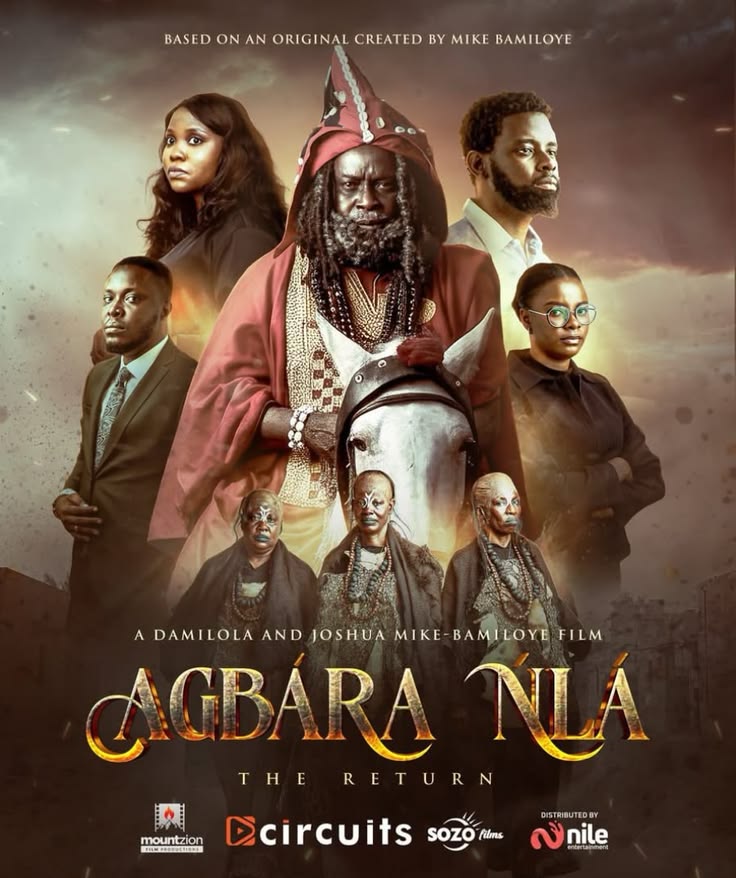
For a generation of Nigerian Christians, the name Agbara Nla brings back memories of a film that made spiritual warfare a familiar subject of conversation long before Nigerian faith-based productions began competing for space in mainstream cinemas. Its central antagonist, Isawuru, was not simply another film villain; he became one of the memorable figures associated with Mount Zion’s early filmmaking years.
Now, 33 years after the original Yoruba production reached television audiences in 1993, the story has returned to the big screen. But Agbara Nla: The Return is doing more than bringing back a familiar title. It is reopening conversations about Christian filmmaking, cultural representation, nostalgia and the place of faith-based stories in Nigeria’s entertainment industry.
The journey of Agbara Nla began long before its 1993 television broadcast. Veteran Christian filmmaker and Mount Zion Film Productions founder, Evangelist Mike Bamiloye, developed the story during the early years of the ministry’s film-making activities. The initial production attempt, under the title Agbara To Ju Agbara Lo, reportedly collapsed after the cameraman disappeared with the recorded tapes. The project was later revived, rewritten and produced, eventually reaching audiences through television broadcasts in 1993.
The story’s reach expanded in 1994 with the release of its English-language adaptation, The Ultimate Power. This introduced the production to audiences beyond Yoruba-speaking communities and helped establish its place among Mount Zion’s notable Christian film productions.
More than three decades later, the decision to revisit the story came from the next generation of the Bamiloye family. Brothers Damilola Mike-Bamiloye and Joshua Mike-Bamiloye took on the directorial responsibility, reimagining their father’s work for contemporary cinema audiences. Their father, Mike Bamiloye, also returned to portray Isawuru, the character closely associated with the original production.
Produced by Chris Odeh, the new film brings together Mount Zion Film Productions, Circuits and Sozo Films, with Nile Entertainment handling its theatrical distribution. It arrived in Nigerian cinemas on October 1, 2026, Nigeria’s Independence Day.
At the centre of the new production is Muwonleru, a village under the influence of the feared herbalist Isawuru. When Bose and Kola fail to accept the call to take the Gospel to the community, the responsibility falls to Olaboye and Olatomi, who leave their city lives behind to confront the spiritual stronghold. The story explores faith, obedience, sacrifice, spiritual conflict and restoration. Its central premise retains the religious themes that made the original familiar to its audience, while presenting the story through a contemporary cinematic production.
However, the return of Agbara Nla has generated conversations that go beyond its storyline.
For many viewers, the remake represents an opportunity to reconnect with a film that formed part of their childhood and Christian upbringing. The return of Mike Bamiloye as Isawuru has also attracted attention, particularly among those familiar with his portrayal in the original. For younger audiences who did not experience the first production, the cinema release offers an opportunity to encounter a story that had already established a place in Nigerian Christian filmmaking.
The public response has also taken an unusual form. Videos circulated on social media after the film’s release showed cinema audiences singing worship songs, praying and speaking in tongues during screenings. Some viewers described the experience as spiritually moving, while others regarded the reactions as evidence of the strong connection between the production and its Christian audience. These videos attracted considerable attention, although they represent individual audience experiences rather than a measure of how every cinema-goer responded.
The film’s commercial performance has added another dimension to the conversation. According to figures reported by Premium Times, Agbara Nla: The Return generated approximately ₦71.4 million from preview screenings and ₦99.2 million during its opening weekend, bringing its opening total to about ₦170.6 million. The publication reported that the film recorded the biggest non-December opening for a Nigerian film at the time and the strongest opening for a faith-based Nollywood production. By October 18, its reported cumulative gross had reached ₦307.2 million.
Yet, not everyone has received the remake without reservations.
While some viewers have celebrated its return and the attention it has brought to Christian filmmaking, others have questioned aspects of its religious and cultural presentation. One recurring question in the wider discussion is why Christian films give so much attention to witchcraft, occult practices and the activities of spiritual forces. Some viewers have questioned whether such portrayals risk giving these subjects unnecessary prominence or reinforcing negative perceptions of indigenous Yoruba spiritual traditions.
This criticism goes beyond whether a film is entertaining. It raises questions about how religious productions represent traditional beliefs and cultural practices, particularly when those practices are presented almost entirely through the lens of spiritual opposition. A review by The Lagos Review, for instance, questioned the film’s portrayal of Yoruba spiritual practices as inherently malevolent, arguing that improved production techniques do not automatically mean a more nuanced cultural perspective.
Other criticisms have focused on the film’s theological choices. A NaijaWorld review praised its production design, costumes, visual effects and acting but questioned certain depictions of demonic possession, speaking in tongues and spiritual experiences, arguing that they raised biblical concerns. The review demonstrates that even among Christian audiences, there can be disagreement over how spiritual subjects should be represented on screen.
Professional film critics have also offered different assessments. Premium Times gave the remake an 8/10 rating, recognising its nostalgic appeal and improved production while raising concerns about its length, pacing and storytelling. Afrocritik, meanwhile, praised its visual presentation but criticised aspects of its character development, predictable narrative and treatment of redemption.
These differing reactions reveal an important part of the film’s return: Agbara Nla is not simply being received as a piece of entertainment. It is also being discussed as a Christian production, a cultural work and a remake of a story that already carries meaning for many Nigerians. That places expectations on its creators that extend beyond modern cameras, sound, visual effects and familiar characters.
Ultimately, the return of Agbara Nla offers an opportunity to reflect on how far Nigerian Christian filmmaking has travelled since the original production reached television audiences in 1993. It also highlights the responsibility that comes with revisiting an established story: preserving what made it meaningful to its original audience while recognising that contemporary viewers may ask different questions.
Thirty-three years after its first release, Agbara Nla has found its way back into public conversation, this time on cinema screens and across social media. Whether remembered with nostalgia, welcomed as a new cinematic experience or questioned for its religious and cultural choices, its return has renewed attention on the influence and possibilities of Christian storytelling in Nigeria.